Public Safety Program

Dedicated to Transit Safety

Report Concerns

Report non-emergencies by calling the GO Line at 512-474-1200.
For emergencies, call/text 911

Call Now

We all play a role in keeping transit safe.

Part of creating a modern approach to public safety is rethinking the roles and responsibilities of its team members.

To provide an appropriate and effective response to the safety needs on transit, our Public Safety Program is composed of three teams that work together.

Customer Comments

Share your feedback and suggestions.

Leave A Comment

What is the GO Line

Call the GO Line to immediately contact customer support.

  • Report a safety concern or suspicious behavior
  • Report a non-emergency onboard CapMetro or at the stop/station
  • When you need any other help

What Happens After You Report a Concern

Our dispatchers evaluate the report and deploy the appropriate resource. For non-violent disruptions, policy violations, or general assistance, trained Public Safety Ambassadors on the ground or mobile units will check vehicles, stops or stations. If the situation involves individuals needing social support (such as housing, food, or medical resources), on-staff social workers step in to provide specialized assistance. For serious or dangerous criminal incidents, CapMetro dispatches our Transit Police Officers or the Austin Police Department. 

For driver behavior or non-urgent safety feedback, we log and review the vehicle number, time and route details internally to take corrective or disciplinary action.

How to use the GO Line

Call the GO Line at 512-474-1200 to report suspicious activity. For emergencies, call 9-1-1.

Be ready to share:

  • Your route number
  • The stop ID or nearest intersection
  • The 4-digit vehicle number (found inside and outside the vehicle)

You may remain anonymous.

2026 Annual Safety Policy Review

CapMetro strives for continuous improvement of our policies and procedures, so we've conducted an annual review of our Transit Police policies. If you want to provide feedback on the reviewed policies or request more information, including final versions of any policy, email engage@capmetro.org.

Below is the list of policies that have been updated and a summary of the changes made to each policy, as well as a list of the remaining policies that were unchanged.

337 Generative Artificial Intelligence Use: Updated to align Transit Police Department GenAI use with CapMetro’s agency-wide GenAI policy, including applicable disclosure requirements.

700 Department Owned & Personal Property: Updated to align property damage reporting with CapMetro’s claims process, including notification to Business Insurance and Claims when potential claims arise.

701 Personal Communication Devices: Updated to restrict the on-duty use of personally owned smart glasses, wearable cameras, and similar electronic devices, with exceptions for Department-authorized equipment and medically necessary devices or approved accommodations.

703 Vehicle Use: Removed the section specific to unmarked vehicles because their use is governed by CapMetro’s agency-wide vehicle policy; remaining sections were renumbered accordingly.

802 Property & Evidence Section: Added requirements for the field release of found and safekeeping property, including verification of ownership and documentation of the release.

803 Records Section: Added procedures for accessing and confirming warrant information, including requirements to verify warrants prior to arrest and clarify responsibilities for maintaining warrant records.

900 Temporary Custody of Adults: Updated to clarify the scope of temporary custody as CapMetro does not operate a jail or holding facility. Revised requirements to reflect the Department’s actual temporary custody practices, including appropriate locations for interviews, supervision and safety requirements, and transfer or release of individuals in custody. Removed provisions applicable to agencies that operate detention or holding facilities and renumbered remaining sections accordingly.

901 Temporary Custody of Juveniles: Updated to clarify the scope of temporary custody as CapMetro does not operate a jail or holding facility or hold juveniles in secure custody at the Department. Revised requirements to reflect the Department’s actual temporary custody practices and transfer of juveniles to an appropriate juvenile detention facility. Removed provisions applicable to agencies that operate detention or holding facilities and renumbered remaining sections accordingly.

902 Custodial Searches: Updated to clarify requirements for searches of individuals in temporary custody and align terminology with the Temporary Custody policies. Added definitions and guidance regarding the scope and duration of temporary custody and made corresponding updates throughout the policy.

1000 Personnel Selection and Background Investigations (previously Recruitment & Selection): Updated the policy title and scope to focus on Transit Police personnel selection and background investigation requirements. Removed Department-specific recruitment provisions and clarified that recruitment for Transit Police positions is conducted in accordance with CapMetro’s agency-wide Staffing Policy and hiring procedures.

1008 Communicable Diseases: Updated to align Transit Police communicable disease prevention and exposure response requirements with CapMetro’s Occupational Health and Safety Manual and applicable programs, including coordination with the Safety Department.

1009 Smoking and Tobacco Use: Updated to align Transit Police smoking, tobacco, and vaping requirements with CapMetro’s agency-wide Tobacco, Smoke, and Vape Free Workplace Policy.

1019 Secondary Employment: Updated to allow approved secondary employment in certain law enforcement roles, subject to prior written approval and applicable requirements of Texas Occupations Code Chapter 1702 and Department policy.

1027 Illness and Injury Prevention: Updated to align Transit Police work-related illness and injury reporting with CapMetro’s agency-wide procedures and applicable requirements, and to clarify coordination of injury reporting with the Department’s investigation process.

1029 Wellness Program: Updated to align Transit Police wellness guidance with CapMetro’s agency-wide Wellness Policy. Removed duplicative Department-specific wellness program provisions and directed personnel to the agency policy for applicable requirements and resources.

  • Law Enforcement Authority 
  • Chief Administrator 
  • Oath of Office 
  • Policy Manual 
  • Mission, Vision, Core Values & Law Enforcement Code of Ethics
  • Organizational Structure and Responsibility
  • Departmental Directives
  • Emergency Response Plan
  • Training 
  • Administrative Communications
  • Supervision Staffing Levels 
  • Retiree Concealed Firearms 
  • Use of Force 
  • Use of Force Review Boards 
  • Handcuffing and Restraints 
  • Control Devices 
  • Conducted Energy Device 
  • Officer-Involved Shootings and Deaths 
  • Firearms
  • Vehicle Pursuits
  • Foot Pursuits 
  • Officer Response to Calls 
  • Family Violence 
  • Search and Seizure
  • Child Abuse 
  • Adult Abuse
  • Missing Persons
  • Public Alerts - Victim and Witness Assistance
  • Hate Crimes 
  • Standards of Conduct
  • Information Technology Use
  • Department Use of Social Media
  • Report Preparation
  • Media Relations
  • Subpoenas and Court Appearances 
  • Part-Time Officers- Outside Agency Assistance
  • Major Incident Notification
  • Death Investigation
  • Identity Theft
  • Limited English Proficiency Services 
  • ADA Compliance
  • Biological Samples
  • Child and Dependent Adult Safety
  • Service Animals
  • Native American Graves Protection and Repatriation
  • Off-Duty Law Enforcement Actions
  • Community Relations
  • Patrol
  • Bias-Based Policing
  • Roll call
  • Crime and Disaster Scene Integrity
  • Ride-Alongs
  • Hazardous Material Response 
  • Hostage and Barricade Incidents 
  • Response to Bomb Calls
  • Crisis Intervention Incidents 
  • Emergency Detentions
  • Citation Releases
  • Foreign Diplomatic and Consular Representatives
  • Rapid Response and Deployment
  • Immigration Violations
  • Aircraft Accidents
  • Field Training
  • Air Support
  • Contacts and Temporary Detentions 
  • Watch Commanders
  • In-Car Camera Video
  • Mobile Data Terminal Use
  • Body-Worn Cameras
  • Public Recording of Law Enforcement Activity
  • Bicycle Patrol 
  • Automated License Plate Readers (ALPRs)
  • Unhoused Persons
  • Medical Marijuana
  • Medical Aid and Response
  • First Amendment Assemblies
  • Civil Disputes
  • Suspicious Activity Reporting
  • Traffic
  • Traffic Collisions
  • Vehicle Towing
  • Impaired Driving
  • Traffic and Parking Citations
  • Disabled Vehicles
  • Investigation and Prosecution
  • Sexual Assault Investigations
  • Eyewitness Identification
  • Brady Information
  • Unmanned Aerial System
  • Warrant Service
  • Operations Planning and Deconfliction
  • Vehicle Maintenance
  • Personal Protective Equipment
  • Crime Analysis 
  • The Combined Transportation Emergency Communication Center (CTECC)
  • Records Maintenance and Release
  • Protected Information
  • Animal Control
  • Custodial Searches
  • Transporting Persons in Custody
  • Performance Evaluations
  • Special Assignments and Promotions
  • Grievances
  • Anti-Retaliation
  • Reporting of Arrests, Convictions and Court Orders
  • Drug- and Alcohol-Free Workplace
  • Sick Leave 
  • Personnel Complaints 
  • Seat Belts
  • Body Armor
  • Personnel Records
  • Request for Change of Assignment 
  • Fitness for Duty 
  • Meal Periods
  • Lactation Breaks
  • Occupational Disease, Work-Related Injury and Death Reporting
  • Personal Appearance Standards
  • Uniforms and Civilian Attire
  • Conflict of Interest
  • Badges, Patches and Identification
  • Temporary Modified-Duty Assignments
  • Speech, Expression, and Social Networking
  • Line-of-Duty Deaths

Our Safety Approach

As the Central Texas transit system continues to grow, CapMetro faces challenges to ensuring public safety such as:

  • Availability and flexibility of staff
  • Service area across multiple jurisdictions
  • Rapid ridership growth
  • Special event management (larger events, held more often)

How does the approach address the growing challenges?
Our three-team approach for public safety is making rides safer for everyone. Our approach strategically uses resources, ensuring that riders feel safe and get the precise help they need, when they need it. This is how our teams work together:

Public Safety Ambassadors: These front-line customer service ambassadors are our eyes and ears on the ground. They ride CapMetro services and are trained to respond to immediate safety concerns, provide directions and connect riders with appropriate resources.

Community Intervention Specialists: When more comprehensive assistance is needed, our Community Intervention Specialists step in. These on-staff social workers are equipped to connect individuals to essential resources, such as housing, food or healthcare, ensuring a supportive and responsive approach to each unique situation.

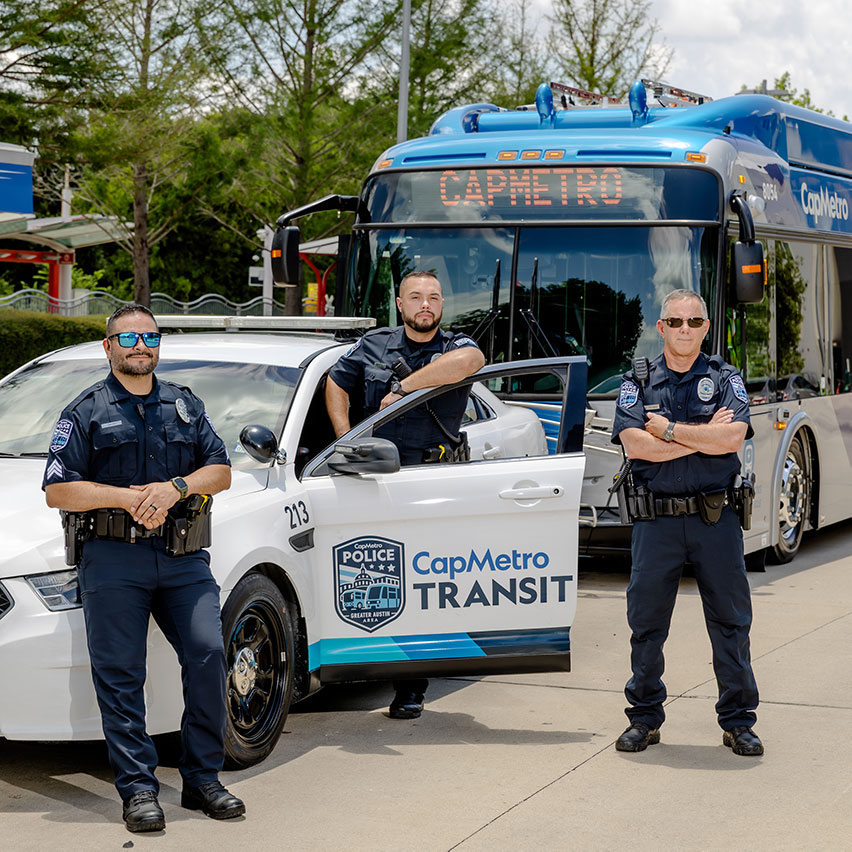
Transit Police Officers: For those rare moments when law enforcement is necessary, our dispatchers are on standby to call a dedicated police team. Our Transit Police team is trained specifically for our transit environment, ensuring focused and effective responses.

To enhance safety across our growing system, CapMetro is implementing several key measures and tools:


Enhanced Surveillance: We are increasing the number of security cameras and upgrading safety infrastructure on vehicles and at facilities. This aids in the quicker identification and resolution of issues.

Swift Response: We are committed to reducing response times where possible for both staff and customer concerns, ensuring swift and effective action when needed.

Comprehensive Coverage: Our safety measures extend throughout the area that CapMetro serves, ensuring consistent protection across our facilities and our vehicles.

Direct Support: We are able to provide direct support for our staff through training and policies, allowing us to adapt and implement the most effective safety strategies.

These measures create a Public Safety program that is the right size for today's system and able to support the growth of our region, the services we're planning for tomorrow and the ridership that will come as a result of our Project Connect expansion program.

See something? Say something. Report suspicious activity by calling the GO Line at 512-474-1200
or dial 9-1-1 for emergencies.

Provide the route you’re riding, Stop ID number where you’re waiting or a street intersection. If applicable, provide the 4-digit vehicle number, located inside and outside every CapMetro vehicle. You can do this anonymously.

Code of Conduct

CapMetro's Code of Conduct extends across all vehicle types as well as our stops and transit hubs. Before you ride, please read these rules and expectations.

Read Our Code of Conduct

Public Safety Advisory Committee

A 10-member community group that provides input and recommendations to help guide and develop CapMetro's public safety program.

Learn More